Tag Archives: documentary


The Last Train Home: Following One Migrant Family’s Struggles

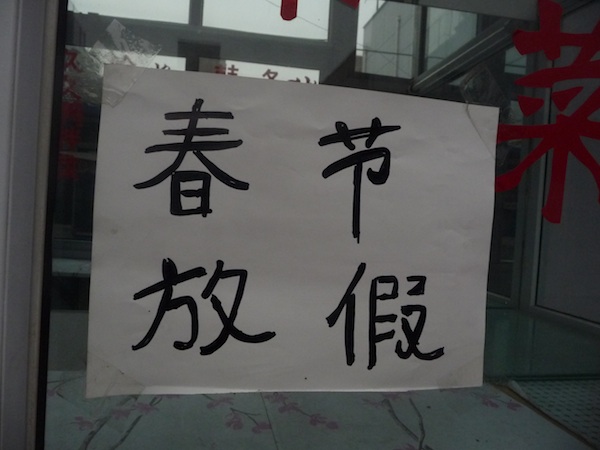
A sign in Beijing's Caochangdi reads "On vacation for Spring Festival".

A sign in Beijing's Caochangdi reads "On vacation for Spring Festival".

Chunjie aka Spring Festival aka Chinese New Year is here!  It was my first month in China last year, and I had just moved to Beijing.  I vividly remember dropping off my roommate at Beijing airport for her own participating in Chunyun–the elegant word-pairing that sums up the largest annual human migration on earth–and then taking the elevated Airport Express line back to the city.

A shot I took of the empty Airport Highway in Beijing during Spring Festival 2011.

A shot I took of the empty Airport Highway in Beijing during Spring Festival 2011.

From above the city and its famous ring roads, I was awestruck.  I’d seen New York’s Broadway Ave. empty out for Thanksgiving and Los Angeles’s 405 lighten up on Christmas Day, but I’d never before seen entire highways–just days before clogged with incomprehensible traffic–empty but for one or two cars.  I quickly snaped a few images for a short photo essay.

It would be my first real introduction to the magnitude of Beijing’s migrant community.  I spent the rest of 2011 living and working in Caochangdi, an art village and migrant community just outside Beijing’s Fifth Ring Road, and I got to know the families and young men and women who traveled to the city from all over China with the hopes of improving their opportunities in life as the country marches toward urbanization.

Which got me thinking about a film I have to recommend strongly to 88 Bar readers.  Lixin Fan’s Last Train Home (归途列车) is a narrative documentary focusing on one rural Sichuanese family, the Zhangs.  For 16 years, Mom and Dad Zhang have been working in Guangzhou, leaving behind a son and daughter to be cared for by their grandparents.  The film starts with the couple making the annual trek home for Spring Festival alongside some 300 million others.  It then follows the awkward reunion with their son and teenage daughter.

Set amidst stunning scenes of the Yangtze River, garment factories and the overworked train system, Last Train Home gives us a rare peek inside the personal struggles of one migrant family.  One didactic scene, when one worker waxes poetic about the difference between Chinese and Western standards of living, serves less to preach to viewers and more to show us that the armies of workers who make our clothes and iPhones with record efficiency are living, thinking human beings.  And they’re no fools about the new world order brought about by globalization.

What’s important about this film is that it shows the very human side of this mass migration.  It can be fascinating to rattle off statistics–690.79 million people living in cities, 3.2 trillion US dollars’ worth of foreign reserves2 billion square meters of new buildings each year–but in so doing, it’s easy to forget the people caught up in what is inarguably an historic moment for the country and the world.

Here’s a trailer to the film, and fortunately for you Netflix buffs, it’s available on Netflix Instant. (You can also order the DVD here.)

Animated documentary about elderly in Hong Kong

Reposted with permission from World Wide Pop.

The Postgal Workshop (猫室) has become the champion of homegrown animation in Hong Kong. Its recent comic book and animated shorts series, Din Dong (癲噹), went from being a local indie favorite to being aired on Japanese TV. Din Dong is a parody of the popular Japanese cartoon, Doraemon (ドラえもん). The characters are named after those in Doraemon (in fact “Din Dong” is a pun on what Doraemon was called in Hong Kong before its phonetically correct name change in 1999) and the story is set in an ambiguously Asian village beset by the financial recession.

Despite an interesting premise, Din Dong, like many of the Postgal Workshop’s animated works, suffers from mediocre writing, relying way too readily on cute gags and silly endings. When applied to ads, as it was for Hong Kong’s blockbuster apm shopping mall, the animation thrives from its unique look and feel. When applied to story-driven works like Din Dong, the writing and dialogue feel out of sync with the exceptional Postgal animation style.

Advertisers employ Postgal to make sure they connect with the young demographic. I suspect RTHK (the social issues, government-funded broadcasting organization in Hong Kong) reached out to them for the similar reasons. In 2008, they commissioned Postgal to create an animated episode of their Hong Kong Connection (鏗鏘集) documentary series. This unlikely collaboration created one of Postgal’s best works to date by forcing them play serious and incorporate new voices.

The animated episode is called Hidden Elders (隱蔽老人) and describes the plight of forgotten or “hidden” senior residents in Hong Kong. The juxtaposition of serious subject matter and frivolous animation style livens up a normally-dry subject matter. Additionally, the sequencing and writing adds a surprisingly effective layer of wit and charm. On the other hand, weaknesses in writing do remain in a few spot (don’t tell me I didn’t warn you about the vapid Star Ferry reference at the end) and there’s a dearth of information about which aspects were fictionalized and which weren’t.

Despite its shortcomings, Hidden Elders is a joy to watch, and captures the city of Hong Kong in spirited cartoon form. It definitely meets its goal of making Hong Kong Connection accessible to new audiences, while spinning the documentary formula on its head. For its efforts, Postgal was awarded the Grand Prize at the 10th Tokyo Broadcasting System’s DigiCon6 Awards in 2008.

And guess what? We’ve subtitled the full episode of Hong Kong Connection: Hidden Elders in English for your viewing pleasure below.

See the original article here.